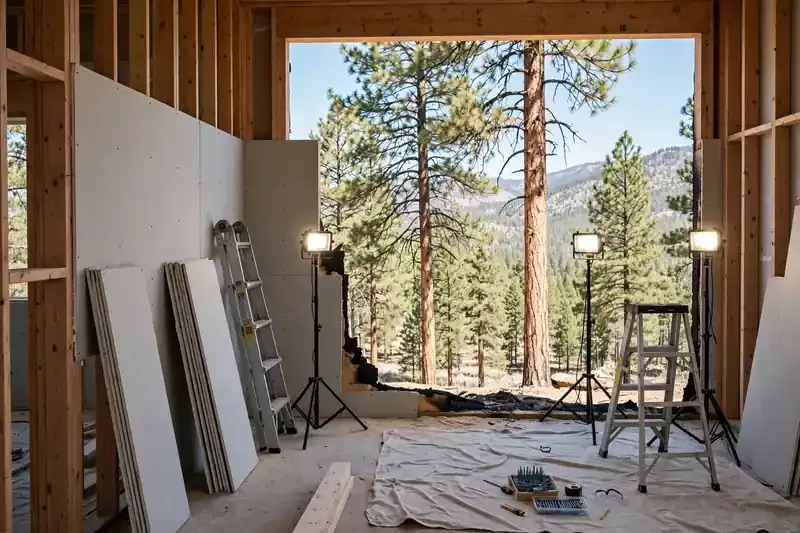
How does fire damage repair & rebuild work in Flagstaff?
Fire damage repair in Flagstaff is the reconstruction stage after a fire: replacing charred framing and roofing, rewiring burned circuits, new insulation and drywall sealed against smoke odor, then cabinets, flooring, paint and trim. Work is permitted through the City of Flagstaff or Coconino County and built to current code. Small repairs start near $5,000; major rebuilds run $100,000 or more.
Repair comes last, and that order matters
The most expensive mistake after a fire is rebuilding too soon. New drywall over framing that still holds smoke odor traps the smell for good. New flooring over a subfloor still wet from firefighting invites mold. Fire damage repair starts only after the house is secured with board-up, dried from firefighting water, and cleaned through smoke damage cleanup and soot removal.
Before closing walls, ask to see two things: final moisture readings showing framing is dry, and confirmation that framing near the fire was cleaned and sealed with an odor-blocking primer.
What fire damage repair includes
| Trade | Typical fire repair work |
|---|---|
| Structural | Replacing or sistering charred studs, joists and rafters; engineer review for heavy damage |
| Roofing | New sheathing, underlayment and roofing where fire or ventilation cuts damaged it |
| Electrical | Rewiring burned circuits, new boxes, devices and panel work by a licensed electrician |
| Plumbing and HVAC | Replacing melted lines, damaged ducts and fire-exposed equipment |
| Insulation and drywall | New insulation, drywall, texture matched to undamaged rooms |
| Finishes | Sealing primer, paint, cabinets, counters, flooring, doors and trim |
| Windows and siding | Replacing heat-cracked windows and warped or burned siding |
Permits, code and Flagstaff conditions
Structural, electrical, plumbing, mechanical and roofing repairs generally need permits. Inside city limits that means the City of Flagstaff; homes in unincorporated areas such as Doney Park, Kachina Village, Mountainaire, Bellemont, Parks and Munds Park go through Coconino County. Rebuilt areas usually have to meet current code, which can mean updated wiring, smoke and carbon monoxide alarms and other upgrades. Many homeowners policies include ordinance-or-law coverage for that cost; check yours.
Building at altitude also shapes the rebuild:
- Snow load. Roof framing and sheathing must carry Flagstaff's design snow loads, which are far higher than the Valley's.
- Wildfire-resistant materials. Homes at the forest edge benefit from ember-resistant vents, Class A roofing and non-combustible siding near the ground, even when not strictly required.
- Short building season. Exterior work slows in winter storms, so roof and siding repairs are scheduled around the weather.
- Material lead times. Cabinets, windows and specialty finishes can take weeks to reach Flagstaff.
Working with your insurer on the rebuild
Fire rebuild estimates are usually written in the same line-item software insurers use, which makes it easier to compare your contractor's scope with the adjuster's. Read both line by line. Common gaps include texture matching, sealing primer, contents manipulation, code upgrades and permit fees. You choose the contractor, even if the insurer recommends one. For large losses, insurers often pay in stages; tie your contractor's payment schedule to those stages.
Before signing, check the contractor's Arizona Registrar of Contractors license and insurance, and get the schedule, payment terms and change-order process in writing. The fire damage restoration cost guide shows typical ranges for each phase.
Fire damage repair costs
Repairing one room after a contained fire, with drywall, insulation and finishes, typically costs $5,000 to $15,000. A kitchen rebuild after a fire commonly runs $15,000 to $45,000. Replacing a section of roof and attic framing is often $10,000 to $40,000. Major structural fires that affect several rooms or the roof can exceed $100,000. Cleaning, board-up and contents are separate lines that come before or alongside the rebuild.
Fire damage repair for older Flagstaff homes
Fires in older homes near downtown, in the Townsite area and in Sunnyside often uncover conditions that were hidden for decades: undersized framing, knob-and-tube or early cloth-insulated wiring, no insulation in exterior walls, and plaster over wood lath. Repairs in those homes usually go beyond the burned area, because building officials expect the rebuilt section to meet current code and the electrician will not reconnect damaged old circuits.
- Plaster ceilings and walls near the fire are usually removed rather than patched, since soot and heat loosen the bond to the lath.
- Old framing is often rough-sawn and larger than modern lumber, so repairs need sistering or shimming to line up.
- Testing for asbestos and lead paint is common before demolition in homes built before the 1980s.
- Ordinance-or-law coverage in your policy may pay for required upgrades; ask your adjuster early.
Matching what survived
The hardest part of a fire rebuild is often matching the rooms that did not burn: wall texture, trim profiles, flooring that runs into other rooms, and cabinets that only partly burned. Insurers commonly pay to replace continuous flooring and to repaint adjoining walls so the result looks like one house. If an exact match is not available, ask how the contractor plans to transition, and get the plan approved before installation rather than after.
Keeping the rebuild on schedule
Rebuilds stall most often on decisions, not labor. Choose finishes, fixtures and colors early, approve change orders quickly and keep one point of contact between you, the contractor and the adjuster. Ask for a weekly schedule update and a list of decisions due that week. Visiting the house at the end of each phase, before walls are closed or cabinets are set, catches problems while they are still easy to fix.